Effective March 1, 2026 · The complete 13-page SDHSPA rulebook is available below. The original page images preserve tables, diagrams and wording exactly.
Meet-day essentials
Three lifts, three attempts per lift. Review the full rules before you compete.
Explore →State meet records
Explore the current boys’ and girls’ record book.
Explore →Rulebook · Page 1
Read page 1 as text
Updated: Effective March 1, 2026
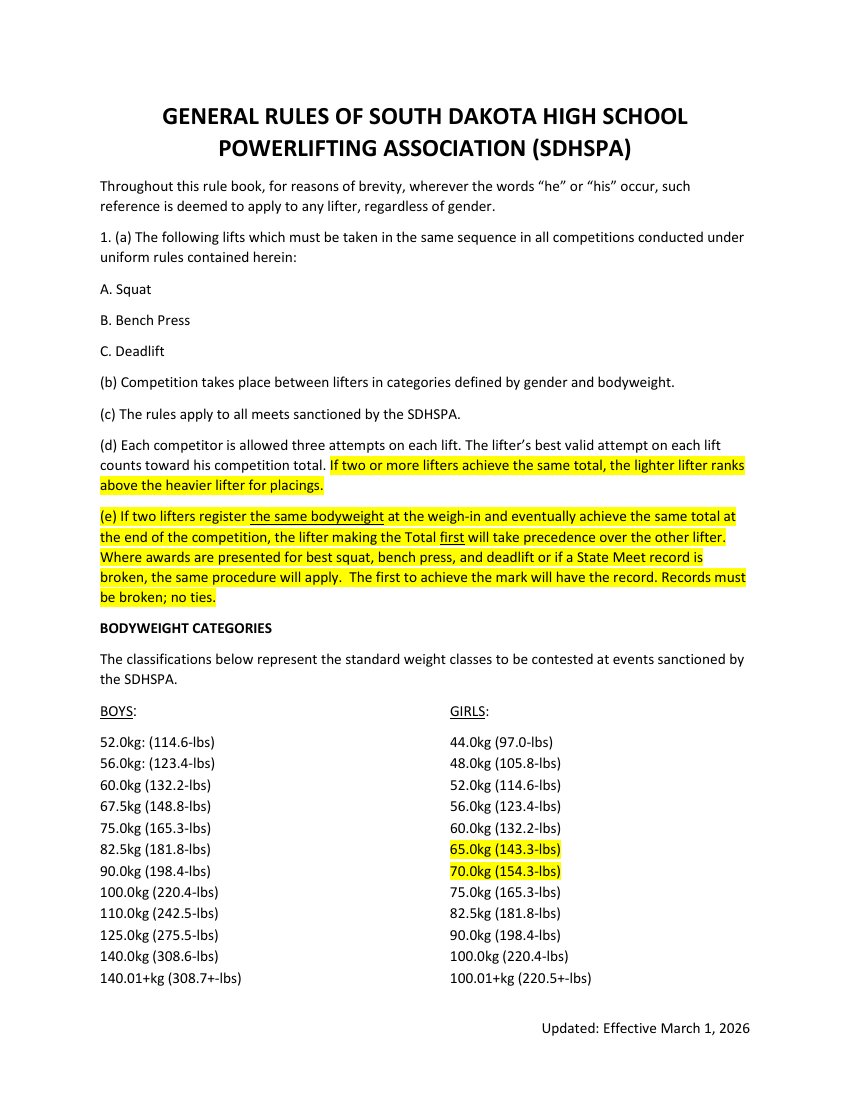
GENERAL RULES OF SOUTH DAKOTA HIGH SCHOOL
POWERLIFTING ASSOCIATION (SDHSPA)
Throughout this rule book, for reasons of brevity, wherever the words “he” or “his” occur, such
reference is deemed to apply to any lifter, regardless of gender.
1. (a) The following lifts which must be taken in the same sequence in all competitions conducted under
uniform rules contained herein:
A. Squat
B. Bench Press
C. Deadlift
(b) Competition takes place between lifters in categories defined by gender and bodyweight.
(c) The rules apply to all meets sanctioned by the SDHSPA.
(d) Each competitor is allowed three attempts on each lift. The lifter’s best valid attempt on each lift
counts toward his competition total. If two or more lifters achieve the same total, the lighter lifter ranks
above the heavier lifter for placings.
(e) If two lifters register the same bodyweight at the weigh-in and eventually achieve the same total at
the end of the competition, the lifter making the Total first will take precedence over the other lifter.
Where awards are presented for best squat, bench press, and deadlift or if a State Meet record is
broken, the same procedure will apply.  The first to achieve the mark will have the record. Records must
be broken; no ties.
BODYWEIGHT CATEGORIES
The classifications below represent the standard weight classes to be contested at events sanctioned by
the SDHSPA.
BOYS:       GIRLS:
52.0kg: (114.6-lbs)     44.0kg (97.0-lbs)
56.0kg: (123.4-lbs)     48.0kg (105.8-lbs)
60.0kg (132.2-lbs)     52.0kg (114.6-lbs)
67.5kg (148.8-lbs)     56.0kg (123.4-lbs)
75.0kg (165.3-lbs)     60.0kg (132.2-lbs)
82.5kg (181.8-lbs)     65.0kg (143.3-lbs)
90.0kg (198.4-lbs)     70.0kg (154.3-lbs)
100.0kg (220.4-lbs)     75.0kg (165.3-lbs)
110.0kg (242.5-lbs)     82.5kg (181.8-lbs)
125.0kg (275.5-lbs)     90.0kg (198.4-lbs)
140.0kg (308.6-lbs)     100.0kg (220.4-lbs)
140.01+kg (308.7+-lbs)     100.01+kg (220.5+-lbs)
Rulebook · Page 2
Read page 2 as text
Updated: Effective March 1, 2026

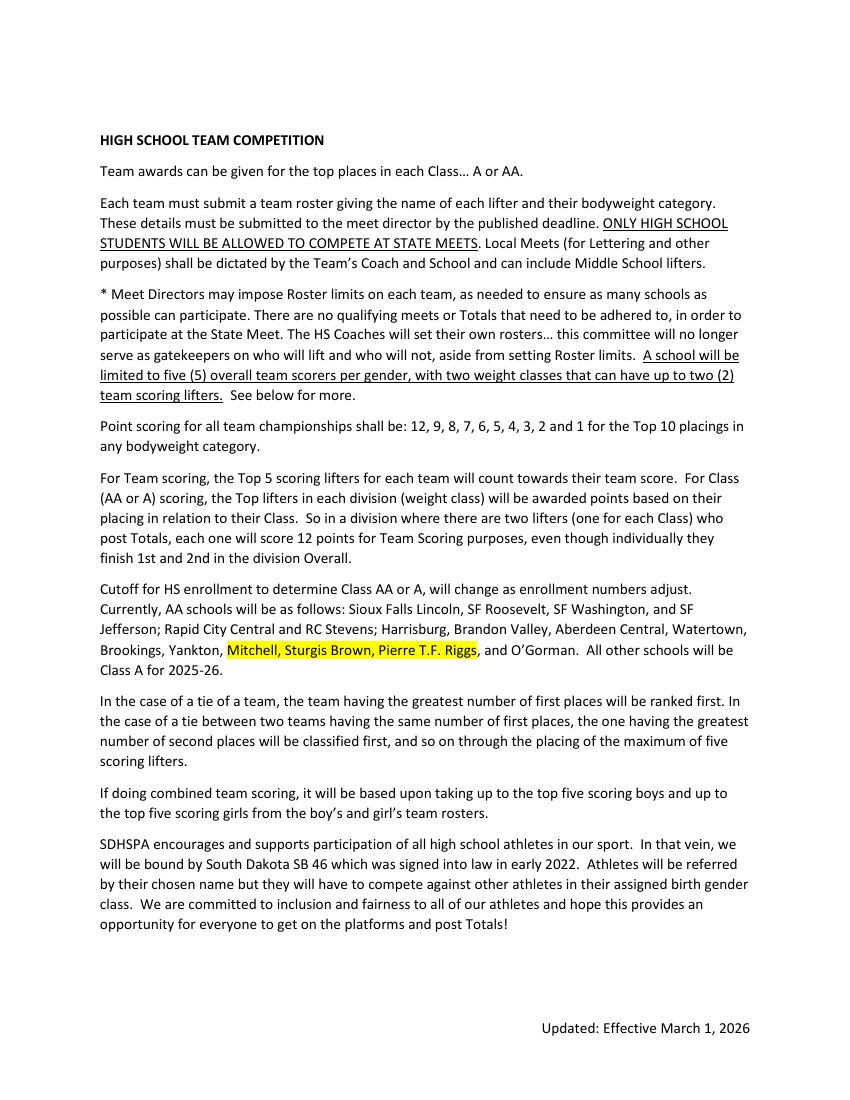
HIGH SCHOOL TEAM COMPETITION
Team awards can be given for the top places in each Class… A or AA.
Each team must submit a team roster giving the name of each lifter and their bodyweight category.
These details must be submitted to the meet director by the published deadline. ONLY HIGH SCHOOL
STUDENTS WILL BE ALLOWED TO COMPETE AT STATE MEETS. Local Meets (for Lettering and other
purposes) shall be dictated by the Team’s Coach and School and can include Middle School lifters.
* Meet Directors may impose Roster limits on each team, as needed to ensure as many schools as
possible can participate. There are no qualifying meets or Totals that need to be adhered to, in order to
participate at the State Meet. The HS Coaches will set their own rosters… this committee will no longer
serve as gatekeepers on who will lift and who will not, aside from setting Roster limits.  A school will be
limited to five (5) overall team scorers per gender, with two weight classes that can have up to two (2)
team scoring lifters.  See below for more.
Point scoring for all team championships shall be: 12, 9, 8, 7, 6, 5, 4, 3, 2 and 1 for the Top 10 placings in
any bodyweight category.
For Team scoring, the Top 5 scoring lifters for each team will count towards their team score.  For Class
(AA or A) scoring, the Top lifters in each division (weight class) will be awarded points based on their
placing in relation to their Class.  So in a division where there are two lifters (one for each Class) who
post Totals, each one will score 12 points for Team Scoring purposes, even though individually they
finish 1st and 2nd in the division Overall.
Cutoff for HS enrollment to determine Class AA or A, will change as enrollment numbers adjust.
Currently, AA schools will be as follows: Sioux Falls Lincoln, SF Roosevelt, SF Washington, and SF
Jefferson; Rapid City Central and RC Stevens; Harrisburg, Brandon Valley, Aberdeen Central, Watertown,
Brookings, Yankton, Mitchell, Sturgis Brown, Pierre T.F. Riggs, and O’Gorman.  All other schools will be
Class A for 2025-26.
In the case of a tie of a team, the team having the greatest number of first places will be ranked first. In
the case of a tie between two teams having the same number of first places, the one having the greatest
number of second places will be classified first, and so on through the placing of the maximum of five
scoring lifters.
If doing combined team scoring, it will be based upon taking up to the top five scoring boys and up to
the top five scoring girls from the boy’s and girl’s team rosters.
SDHSPA encourages and supports participation of all high school athletes in our sport.  In that vein, we
will be bound by South Dakota SB 46 which was signed into law in early 2022.  Athletes will be referred
by their chosen name but they will have to compete against other athletes in their assigned birth gender
class.  We are committed to inclusion and fairness to all of our athletes and hope this provides an
opportunity for everyone to get on the platforms and post Totals!
Rulebook · Page 3
Read page 3 as text
Updated: Effective March 1, 2026
Judges for State Meets must be APPROVED by SDHSPA.  If you are hosting a meet and using new
judges, send a list of those who are either already judges for an accredited and recognized Federation
(USAPL, APF, etc.) or have taken and successfully passed the SDHSPA Referee’s Test.  For more
information, contact an Executive Committee Member.

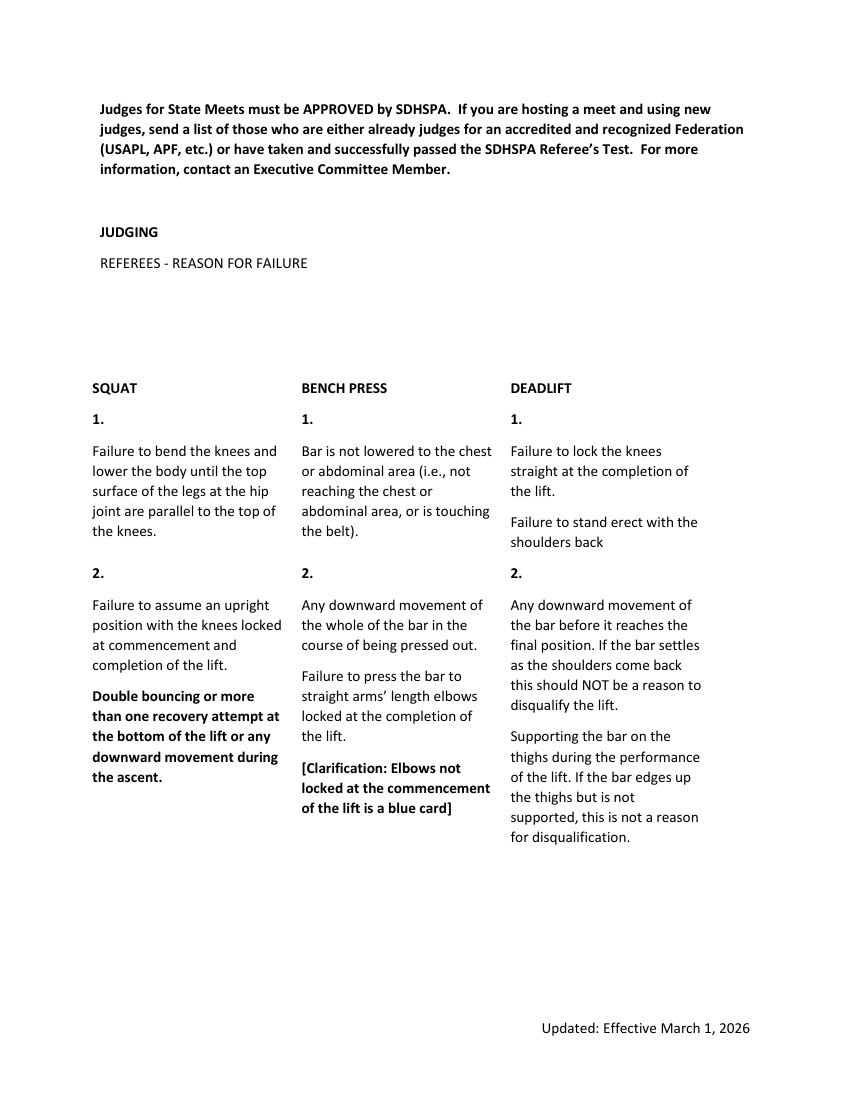
JUDGING
REFEREES - REASON FOR FAILURE


SQUAT


BENCH PRESS


DEADLIFT
1.
Failure to bend the knees and
lower the body until the top
surface of the legs at the hip
joint are parallel to the top of
the knees.
1.
Bar is not lowered to the chest
or abdominal area (i.e., not
reaching the chest or
abdominal area, or is touching
the belt).
1.
Failure to lock the knees
straight at the completion of
the lift.
Failure to stand erect with the
shoulders back
2.
Failure to assume an upright
position with the knees locked
at commencement and
completion of the lift.
Double bouncing or more
than one recovery attempt at
the bottom of the lift or any
downward movement during
the ascent.
2.
Any downward movement of
the whole of the bar in the
course of being pressed out.
Failure to press the bar to
straight arms’ length elbows
locked at the completion of
the lift.
[Clarification: Elbows not
locked at the commencement
of the lift is a blue card]
2.
Any downward movement of
the bar before it reaches the
final position. If the bar settles
as the shoulders come back
this should NOT be a reason to
disqualify the lift.
Supporting the bar on the
thighs during the performance
of the lift. If the bar edges up
the thighs but is not
supported, this is not a reason
for disqualification.
Rulebook · Page 4
Read page 4 as text
Updated: Effective March 1, 2026
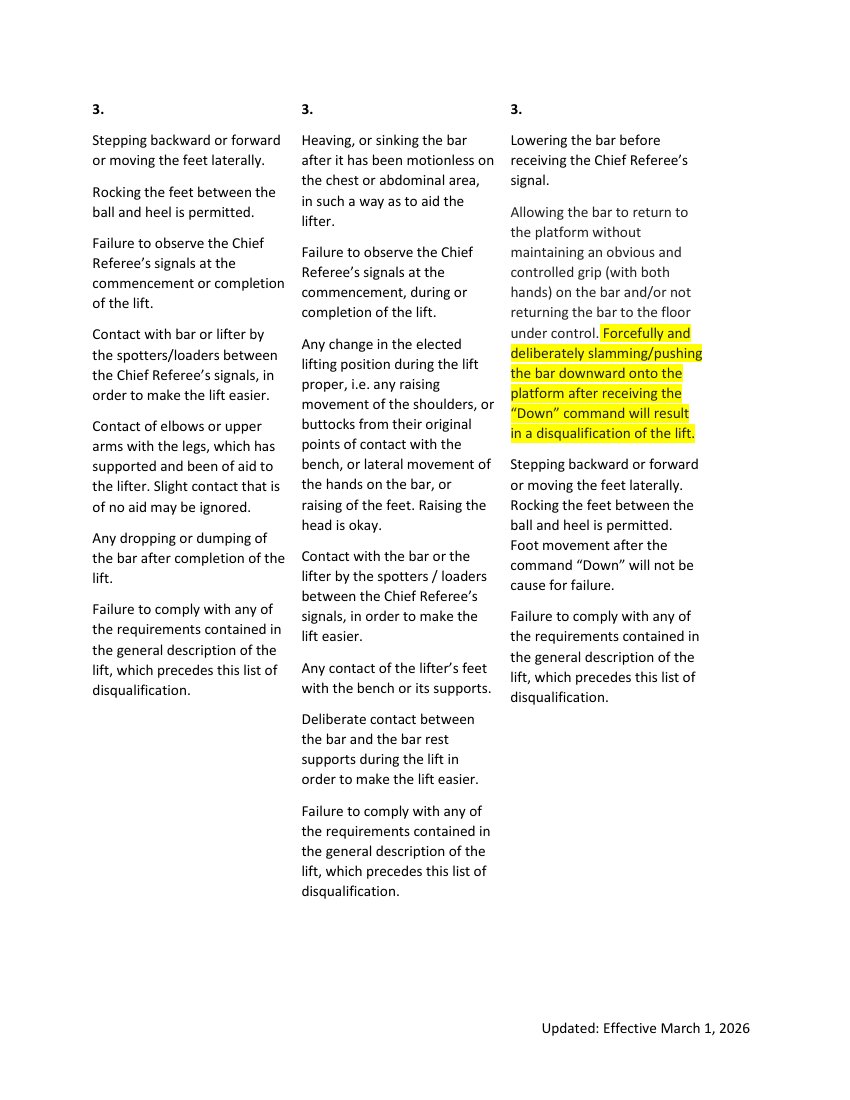
3.
Stepping backward or forward
or moving the feet laterally.
Rocking the feet between the
ball and heel is permitted.
Failure to observe the Chief
Referee’s signals at the
commencement or completion
of the lift.
Contact with bar or lifter by
the spotters/loaders between
the Chief Referee’s signals, in
order to make the lift easier.
Contact of elbows or upper
arms with the legs, which has
supported and been of aid to
the lifter. Slight contact that is
of no aid may be ignored.
Any dropping or dumping of
the bar after completion of the
lift.
Failure to comply with any of
the requirements contained in
the general description of the
lift, which precedes this list of
disqualification.
3.
Heaving, or sinking the bar
after it has been motionless on
the chest or abdominal area,
in such a way as to aid the
lifter.
Failure to observe the Chief
Referee’s signals at the
commencement, during or
completion of the lift.
Any change in the elected
lifting position during the lift
proper, i.e. any raising
movement of the shoulders, or
buttocks from their original
points of contact with the
bench, or lateral movement of
the hands on the bar, or
raising of the feet. Raising the
head is okay.
Contact with the bar or the
lifter by the spotters / loaders
between the Chief Referee’s
signals, in order to make the
lift easier.
Any contact of the lifter’s feet
with the bench or its supports.
Deliberate contact between
the bar and the bar rest
supports during the lift in
order to make the lift easier.
Failure to comply with any of
the requirements contained in
the general description of the
lift, which precedes this list of
disqualification.
3.
Lowering the bar before
receiving the Chief Referee’s
signal.
Allowing the bar to return to
the platform without
maintaining an obvious and
controlled grip (with both
hands) on the bar and/or not
returning the bar to the floor
under control. Forcefully and
deliberately slamming/pushing
the bar downward onto the
platform after receiving the
“Down” command will result
in a disqualification of the lift.
Stepping backward or forward
or moving the feet laterally.
Rocking the feet between the
ball and heel is permitted.
Foot movement after the
command “Down” will not be
cause for failure.
Failure to comply with any of
the requirements contained in
the general description of the
lift, which precedes this list of
disqualification.
Rulebook · Page 5
Read page 5 as text
Updated: Effective March 1, 2026
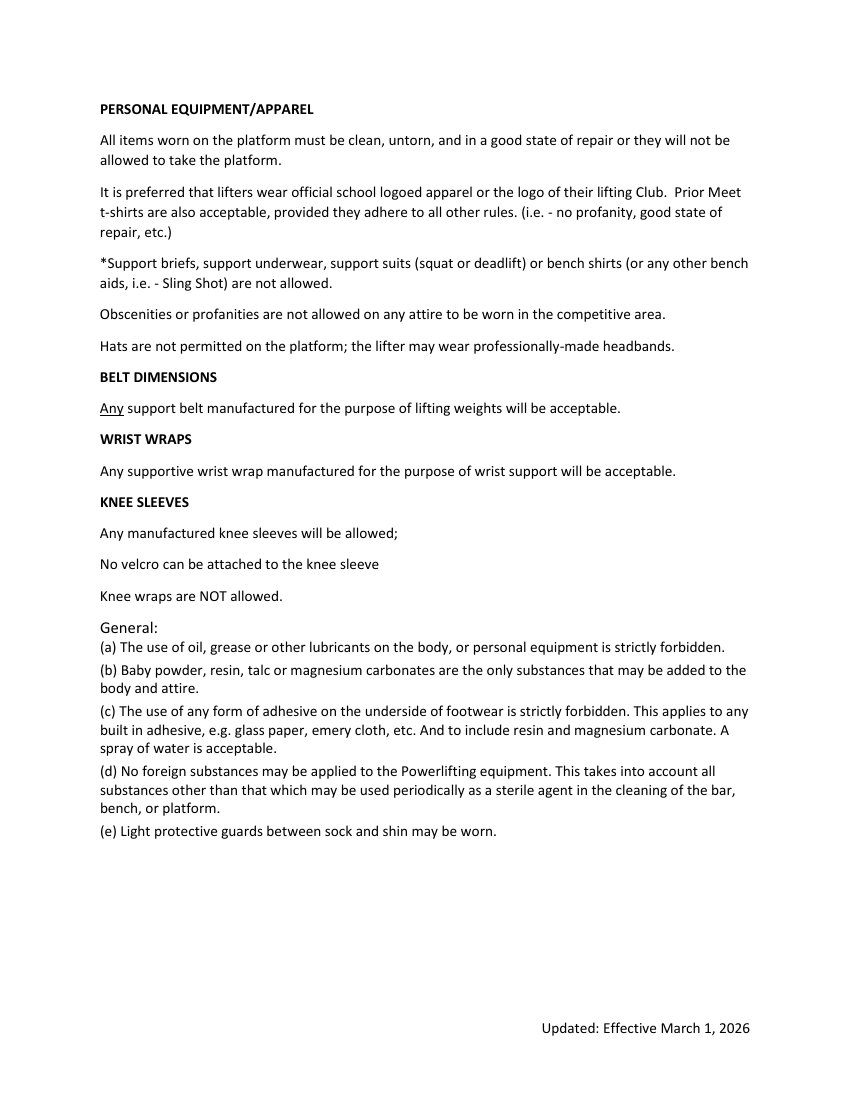
PERSONAL EQUIPMENT/APPAREL
All items worn on the platform must be clean, untorn, and in a good state of repair or they will not be
allowed to take the platform.
It is preferred that lifters wear official school logoed apparel or the logo of their lifting Club.  Prior Meet
t-shirts are also acceptable, provided they adhere to all other rules. (i.e. - no profanity, good state of
repair, etc.)
*Support briefs, support underwear, support suits (squat or deadlift) or bench shirts (or any other bench
aids, i.e. - Sling Shot) are not allowed.
Obscenities or profanities are not allowed on any attire to be worn in the competitive area.
Hats are not permitted on the platform; the lifter may wear professionally-made headbands.
BELT DIMENSIONS
Any support belt manufactured for the purpose of lifting weights will be acceptable.
WRIST WRAPS
Any supportive wrist wrap manufactured for the purpose of wrist support will be acceptable.
KNEE SLEEVES
Any manufactured knee sleeves will be allowed;
No velcro can be attached to the knee sleeve
Knee wraps are NOT allowed.
General:
(a) The use of oil, grease or other lubricants on the body, or personal equipment is strictly forbidden.
(b) Baby powder, resin, talc or magnesium carbonates are the only substances that may be added to the
body and attire.
(c) The use of any form of adhesive on the underside of footwear is strictly forbidden. This applies to any
built in adhesive, e.g. glass paper, emery cloth, etc. And to include resin and magnesium carbonate. A
spray of water is acceptable.
(d) No foreign substances may be applied to the Powerlifting equipment. This takes into account all
substances other than that which may be used periodically as a sterile agent in the cleaning of the bar,
bench, or platform.
(e) Light protective guards between sock and shin may be worn.
Rulebook · Page 6
Read page 6 as text
Updated: Effective March 1, 2026
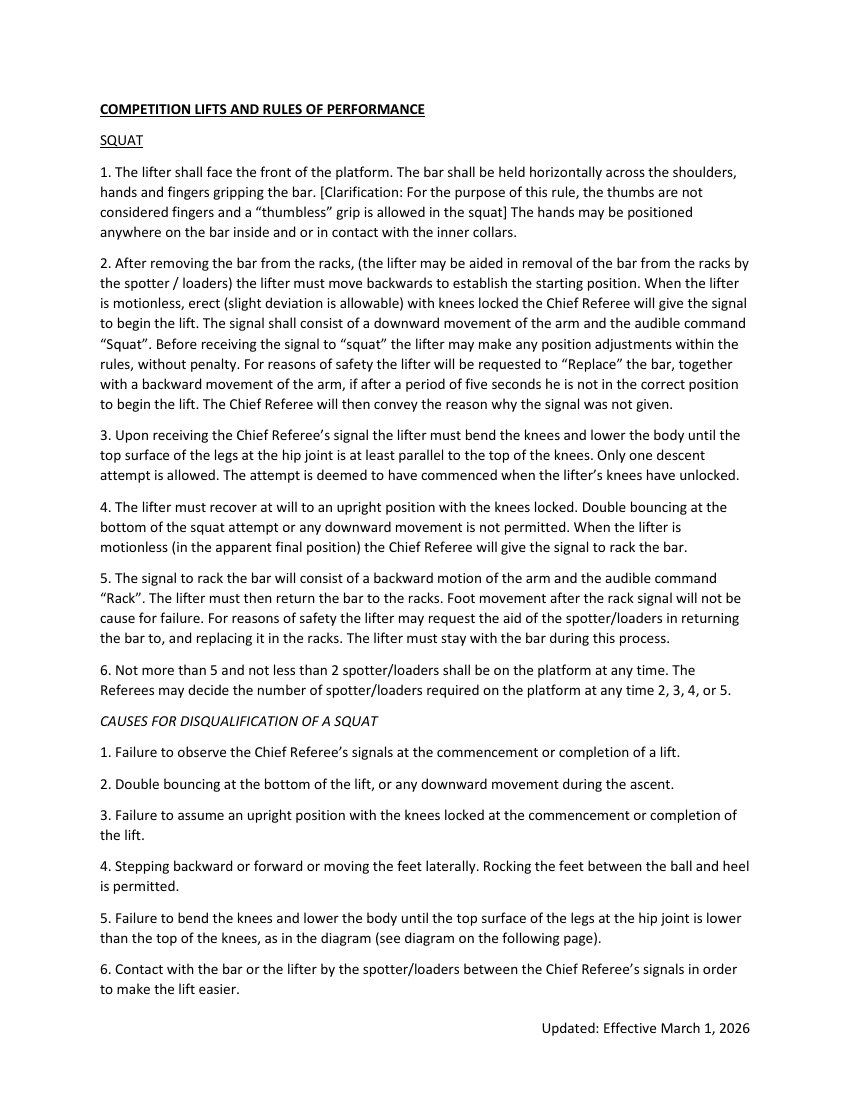
COMPETITION LIFTS AND RULES OF PERFORMANCE
SQUAT
1. The lifter shall face the front of the platform. The bar shall be held horizontally across the shoulders,
hands and fingers gripping the bar. [Clarification: For the purpose of this rule, the thumbs are not
considered fingers and a “thumbless” grip is allowed in the squat] The hands may be positioned
anywhere on the bar inside and or in contact with the inner collars.
2. After removing the bar from the racks, (the lifter may be aided in removal of the bar from the racks by
the spotter / loaders) the lifter must move backwards to establish the starting position. When the lifter
is motionless, erect (slight deviation is allowable) with knees locked the Chief Referee will give the signal
to begin the lift. The signal shall consist of a downward movement of the arm and the audible command
“Squat”. Before receiving the signal to “squat” the lifter may make any position adjustments within the
rules, without penalty. For reasons of safety the lifter will be requested to “Replace” the bar, together
with a backward movement of the arm, if after a period of five seconds he is not in the correct position
to begin the lift. The Chief Referee will then convey the reason why the signal was not given.
3. Upon receiving the Chief Referee’s signal the lifter must bend the knees and lower the body until the
top surface of the legs at the hip joint is at least parallel to the top of the knees. Only one descent
attempt is allowed. The attempt is deemed to have commenced when the lifter’s knees have unlocked.
4. The lifter must recover at will to an upright position with the knees locked. Double bouncing at the
bottom of the squat attempt or any downward movement is not permitted. When the lifter is
motionless (in the apparent final position) the Chief Referee will give the signal to rack the bar.
5. The signal to rack the bar will consist of a backward motion of the arm and the audible command
“Rack”. The lifter must then return the bar to the racks. Foot movement after the rack signal will not be
cause for failure. For reasons of safety the lifter may request the aid of the spotter/loaders in returning
the bar to, and replacing it in the racks. The lifter must stay with the bar during this process.
6. Not more than 5 and not less than 2 spotter/loaders shall be on the platform at any time. The
Referees may decide the number of spotter/loaders required on the platform at any time 2, 3, 4, or 5.
CAUSES FOR DISQUALIFICATION OF A SQUAT
1. Failure to observe the Chief Referee’s signals at the commencement or completion of a lift.
2. Double bouncing at the bottom of the lift, or any downward movement during the ascent.
3. Failure to assume an upright position with the knees locked at the commencement or completion of
the lift.
4. Stepping backward or forward or moving the feet laterally. Rocking the feet between the ball and heel
is permitted.
5. Failure to bend the knees and lower the body until the top surface of the legs at the hip joint is lower
than the top of the knees, as in the diagram (see diagram on the following page).
6. Contact with the bar or the lifter by the spotter/loaders between the Chief Referee’s signals in order
to make the lift easier.
Rulebook · Page 7
Read page 7 as text
Updated: Effective March 1, 2026
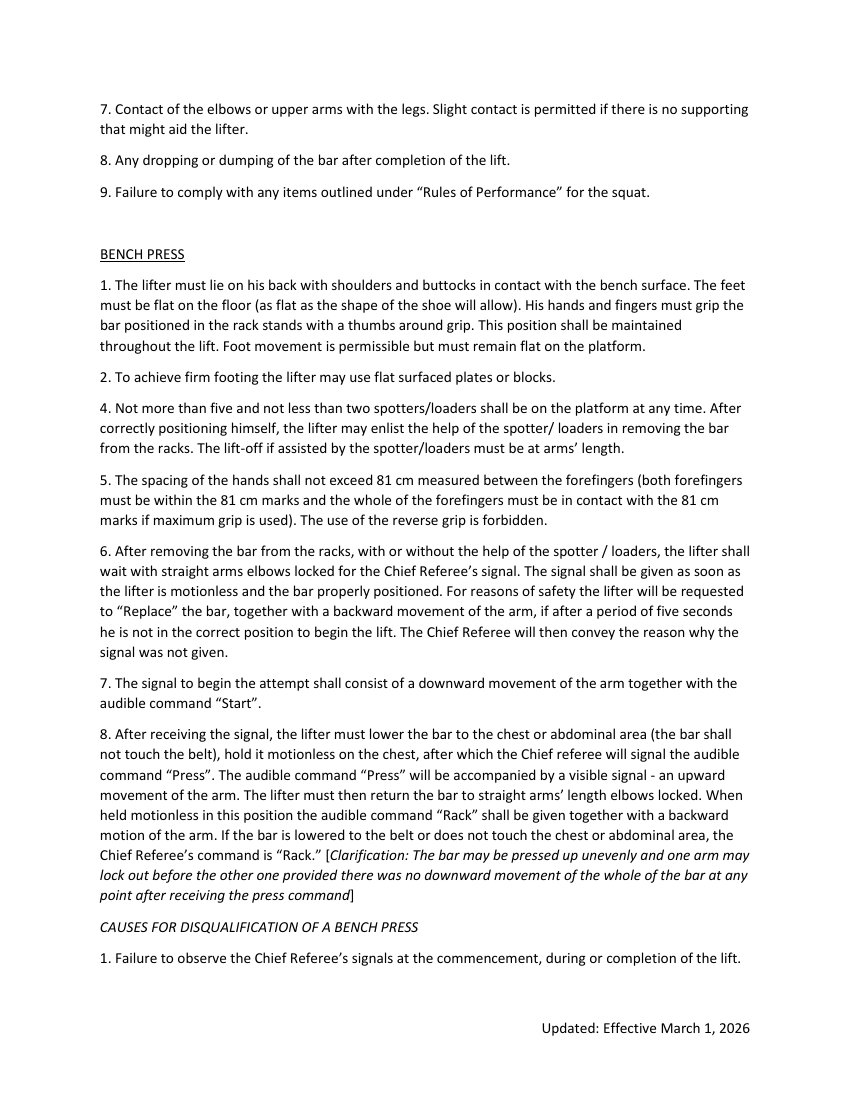
7. Contact of the elbows or upper arms with the legs. Slight contact is permitted if there is no supporting
that might aid the lifter.
8. Any dropping or dumping of the bar after completion of the lift.
9. Failure to comply with any items outlined under “Rules of Performance” for the squat.

BENCH PRESS
1. The lifter must lie on his back with shoulders and buttocks in contact with the bench surface. The feet
must be flat on the floor (as flat as the shape of the shoe will allow). His hands and fingers must grip the
bar positioned in the rack stands with a thumbs around grip. This position shall be maintained
throughout the lift. Foot movement is permissible but must remain flat on the platform.
2. To achieve firm footing the lifter may use flat surfaced plates or blocks.
4. Not more than five and not less than two spotters/loaders shall be on the platform at any time. After
correctly positioning himself, the lifter may enlist the help of the spotter/ loaders in removing the bar
from the racks. The lift-off if assisted by the spotter/loaders must be at arms’ length.
5. The spacing of the hands shall not exceed 81 cm measured between the forefingers (both forefingers
must be within the 81 cm marks and the whole of the forefingers must be in contact with the 81 cm
marks if maximum grip is used). The use of the reverse grip is forbidden.
6. After removing the bar from the racks, with or without the help of the spotter / loaders, the lifter shall
wait with straight arms elbows locked for the Chief Referee’s signal. The signal shall be given as soon as
the lifter is motionless and the bar properly positioned. For reasons of safety the lifter will be requested
to “Replace” the bar, together with a backward movement of the arm, if after a period of five seconds
he is not in the correct position to begin the lift. The Chief Referee will then convey the reason why the
signal was not given.
7. The signal to begin the attempt shall consist of a downward movement of the arm together with the
audible command “Start”.
8. After receiving the signal, the lifter must lower the bar to the chest or abdominal area (the bar shall
not touch the belt), hold it motionless on the chest, after which the Chief referee will signal the audible
command “Press”. The audible command “Press” will be accompanied by a visible signal - an upward
movement of the arm. The lifter must then return the bar to straight arms’ length elbows locked. When
held motionless in this position the audible command “Rack” shall be given together with a backward
motion of the arm. If the bar is lowered to the belt or does not touch the chest or abdominal area, the
Chief Referee’s command is “Rack.” [Clarification: The bar may be pressed up unevenly and one arm may
lock out before the other one provided there was no downward movement of the whole of the bar at any
point after receiving the press command]
CAUSES FOR DISQUALIFICATION OF A BENCH PRESS
1. Failure to observe the Chief Referee’s signals at the commencement, during or completion of the lift.
Rulebook · Page 8
Read page 8 as text
Updated: Effective March 1, 2026
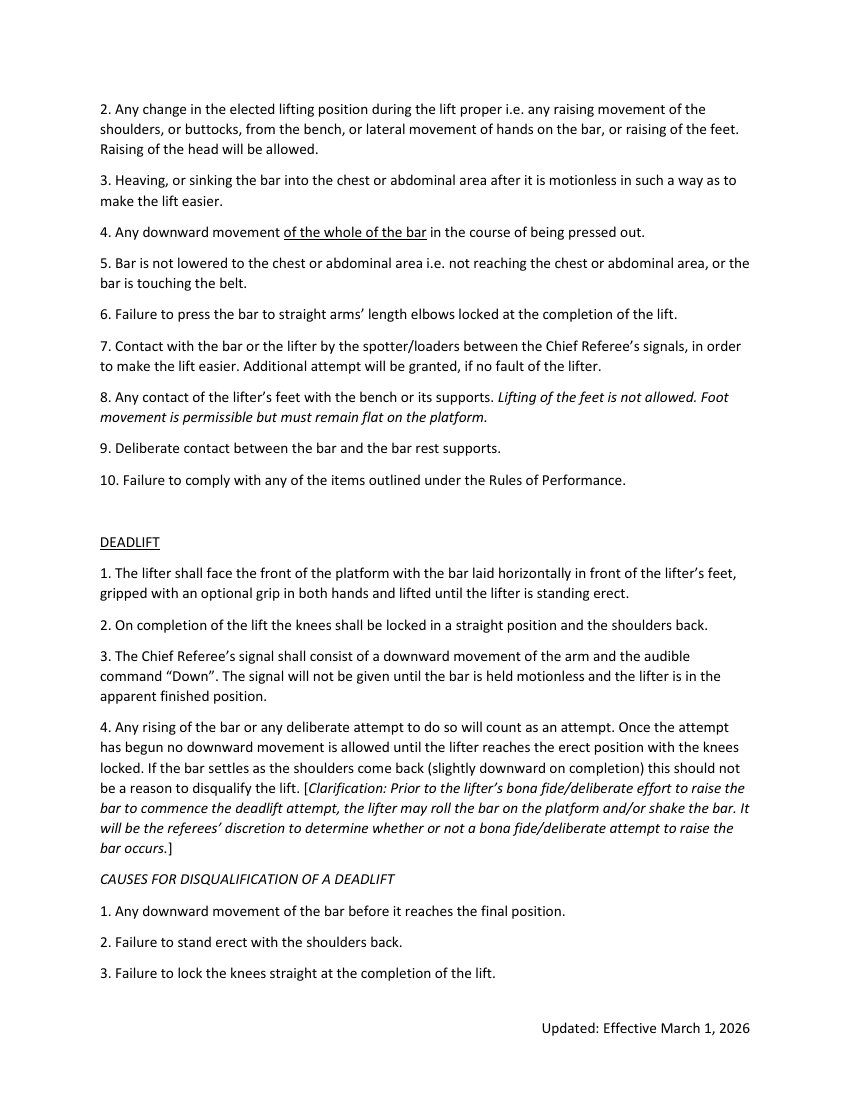
2. Any change in the elected lifting position during the lift proper i.e. any raising movement of the
shoulders, or buttocks, from the bench, or lateral movement of hands on the bar, or raising of the feet.
Raising of the head will be allowed.
3. Heaving, or sinking the bar into the chest or abdominal area after it is motionless in such a way as to
make the lift easier.
4. Any downward movement of the whole of the bar in the course of being pressed out.
5. Bar is not lowered to the chest or abdominal area i.e. not reaching the chest or abdominal area, or the
bar is touching the belt.
6. Failure to press the bar to straight arms’ length elbows locked at the completion of the lift.
7. Contact with the bar or the lifter by the spotter/loaders between the Chief Referee’s signals, in order
to make the lift easier. Additional attempt will be granted, if no fault of the lifter.
8. Any contact of the lifter’s feet with the bench or its supports. Lifting of the feet is not allowed. Foot
movement is permissible but must remain flat on the platform.
9. Deliberate contact between the bar and the bar rest supports.
10. Failure to comply with any of the items outlined under the Rules of Performance.

DEADLIFT
1. The lifter shall face the front of the platform with the bar laid horizontally in front of the lifter’s feet,
gripped with an optional grip in both hands and lifted until the lifter is standing erect.
2. On completion of the lift the knees shall be locked in a straight position and the shoulders back.
3. The Chief Referee’s signal shall consist of a downward movement of the arm and the audible
command “Down”. The signal will not be given until the bar is held motionless and the lifter is in the
apparent finished position.
4. Any rising of the bar or any deliberate attempt to do so will count as an attempt. Once the attempt
has begun no downward movement is allowed until the lifter reaches the erect position with the knees
locked. If the bar settles as the shoulders come back (slightly downward on completion) this should not
be a reason to disqualify the lift. [Clarification: Prior to the lifter’s bona fide/deliberate effort to raise the
bar to commence the deadlift attempt, the lifter may roll the bar on the platform and/or shake the bar. It
will be the referees’ discretion to determine whether or not a bona fide/deliberate attempt to raise the
bar occurs.]
CAUSES FOR DISQUALIFICATION OF A DEADLIFT
1. Any downward movement of the bar before it reaches the final position.
2. Failure to stand erect with the shoulders back.
3. Failure to lock the knees straight at the completion of the lift.
Rulebook · Page 9
Read page 9 as text
Updated: Effective March 1, 2026
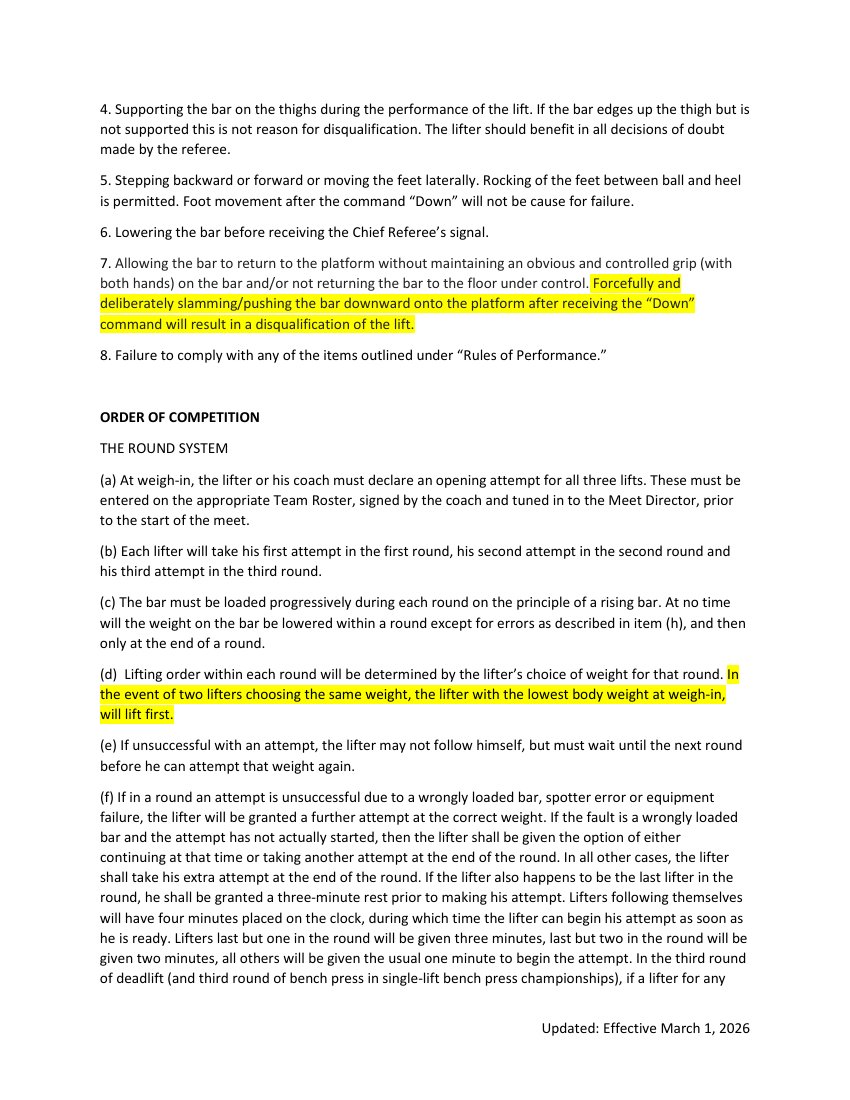
4. Supporting the bar on the thighs during the performance of the lift. If the bar edges up the thigh but is
not supported this is not reason for disqualification. The lifter should benefit in all decisions of doubt
made by the referee.
5. Stepping backward or forward or moving the feet laterally. Rocking of the feet between ball and heel
is permitted. Foot movement after the command “Down” will not be cause for failure.
6. Lowering the bar before receiving the Chief Referee’s signal.
7. Allowing the bar to return to the platform without maintaining an obvious and controlled grip (with
both hands) on the bar and/or not returning the bar to the floor under control. Forcefully and
deliberately slamming/pushing the bar downward onto the platform after receiving the “Down”
command will result in a disqualification of the lift.
8. Failure to comply with any of the items outlined under “Rules of Performance.”

ORDER OF COMPETITION
THE ROUND SYSTEM
(a) At weigh-in, the lifter or his coach must declare an opening attempt for all three lifts. These must be
entered on the appropriate Team Roster, signed by the coach and tuned in to the Meet Director, prior
to the start of the meet.
(b) Each lifter will take his first attempt in the first round, his second attempt in the second round and
his third attempt in the third round.
(c) The bar must be loaded progressively during each round on the principle of a rising bar. At no time
will the weight on the bar be lowered within a round except for errors as described in item (h), and then
only at the end of a round.
(d)  Lifting order within each round will be determined by the lifter’s choice of weight for that round. In
the event of two lifters choosing the same weight, the lifter with the lowest body weight at weigh-in,
will lift first.
(e) If unsuccessful with an attempt, the lifter may not follow himself, but must wait until the next round
before he can attempt that weight again.
(f) If in a round an attempt is unsuccessful due to a wrongly loaded bar, spotter error or equipment
failure, the lifter will be granted a further attempt at the correct weight. If the fault is a wrongly loaded
bar and the attempt has not actually started, then the lifter shall be given the option of either
continuing at that time or taking another attempt at the end of the round. In all other cases, the lifter
shall take his extra attempt at the end of the round. If the lifter also happens to be the last lifter in the
round, he shall be granted a three-minute rest prior to making his attempt. Lifters following themselves
will have four minutes placed on the clock, during which time the lifter can begin his attempt as soon as
he is ready. Lifters last but one in the round will be given three minutes, last but two in the round will be
given two minutes, all others will be given the usual one minute to begin the attempt. In the third round
of deadlift (and third round of bench press in single-lift bench press championships), if a lifter for any
Rulebook · Page 10
Read page 10 as text
Updated: Effective March 1, 2026
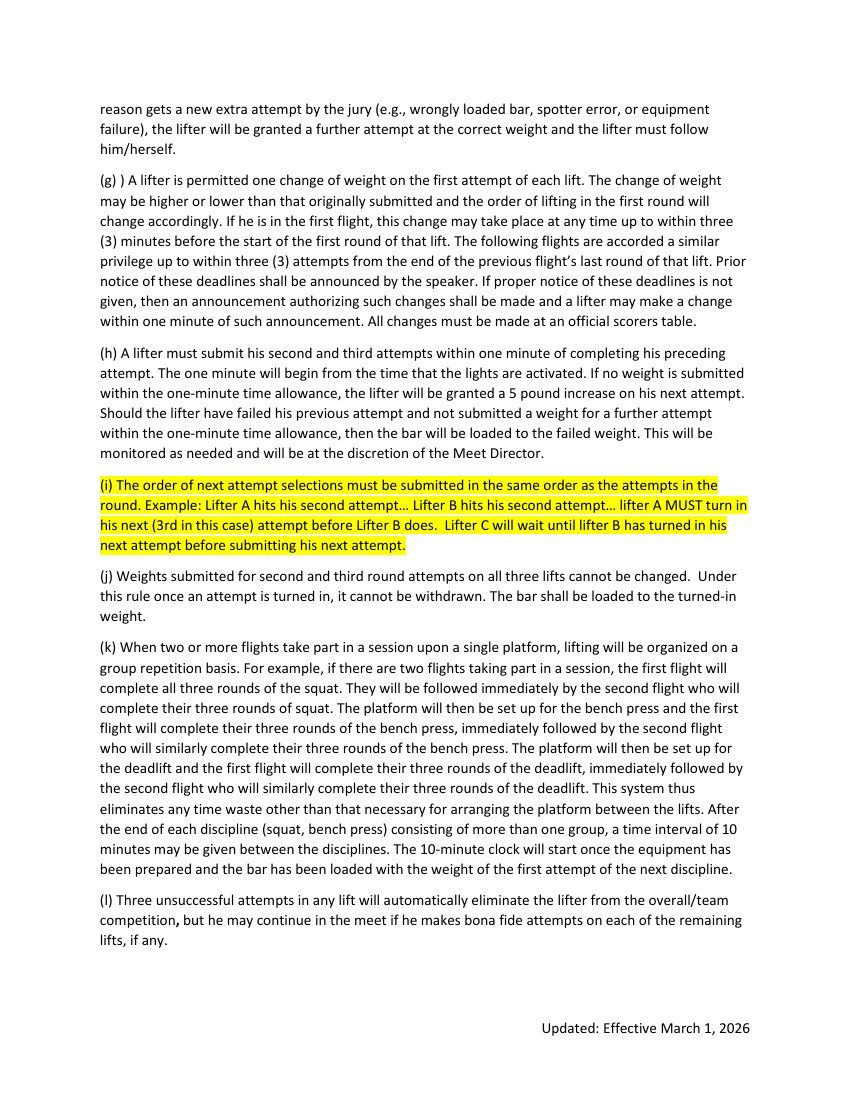
reason gets a new extra attempt by the jury (e.g., wrongly loaded bar, spotter error, or equipment
failure), the lifter will be granted a further attempt at the correct weight and the lifter must follow
him/herself.
(g) ) A lifter is permitted one change of weight on the first attempt of each lift. The change of weight
may be higher or lower than that originally submitted and the order of lifting in the first round will
change accordingly. If he is in the first flight, this change may take place at any time up to within three
(3) minutes before the start of the first round of that lift. The following flights are accorded a similar
privilege up to within three (3) attempts from the end of the previous flight’s last round of that lift. Prior
notice of these deadlines shall be announced by the speaker. If proper notice of these deadlines is not
given, then an announcement authorizing such changes shall be made and a lifter may make a change
within one minute of such announcement. All changes must be made at an official scorers table.
(h) A lifter must submit his second and third attempts within one minute of completing his preceding
attempt. The one minute will begin from the time that the lights are activated. If no weight is submitted
within the one-minute time allowance, the lifter will be granted a 5 pound increase on his next attempt.
Should the lifter have failed his previous attempt and not submitted a weight for a further attempt
within the one-minute time allowance, then the bar will be loaded to the failed weight. This will be
monitored as needed and will be at the discretion of the Meet Director.
(i) The order of next attempt selections must be submitted in the same order as the attempts in the
round. Example: Lifter A hits his second attempt… Lifter B hits his second attempt… lifter A MUST turn in
his next (3rd in this case) attempt before Lifter B does.  Lifter C will wait until lifter B has turned in his
next attempt before submitting his next attempt.
(j) Weights submitted for second and third round attempts on all three lifts cannot be changed.  Under
this rule once an attempt is turned in, it cannot be withdrawn. The bar shall be loaded to the turned-in
weight.
(k) When two or more flights take part in a session upon a single platform, lifting will be organized on a
group repetition basis. For example, if there are two flights taking part in a session, the first flight will
complete all three rounds of the squat. They will be followed immediately by the second flight who will
complete their three rounds of squat. The platform will then be set up for the bench press and the first
flight will complete their three rounds of the bench press, immediately followed by the second flight
who will similarly complete their three rounds of the bench press. The platform will then be set up for
the deadlift and the first flight will complete their three rounds of the deadlift, immediately followed by
the second flight who will similarly complete their three rounds of the deadlift. This system thus
eliminates any time waste other than that necessary for arranging the platform between the lifts. After
the end of each discipline (squat, bench press) consisting of more than one group, a time interval of 10
minutes may be given between the disciplines. The 10-minute clock will start once the equipment has
been prepared and the bar has been loaded with the weight of the first attempt of the next discipline.
(l) Three unsuccessful attempts in any lift will automatically eliminate the lifter from the overall/team
competition, but he may continue in the meet if he makes bona fide attempts on each of the remaining
lifts, if any.
Rulebook · Page 11
Read page 11 as text
Updated: Effective March 1, 2026
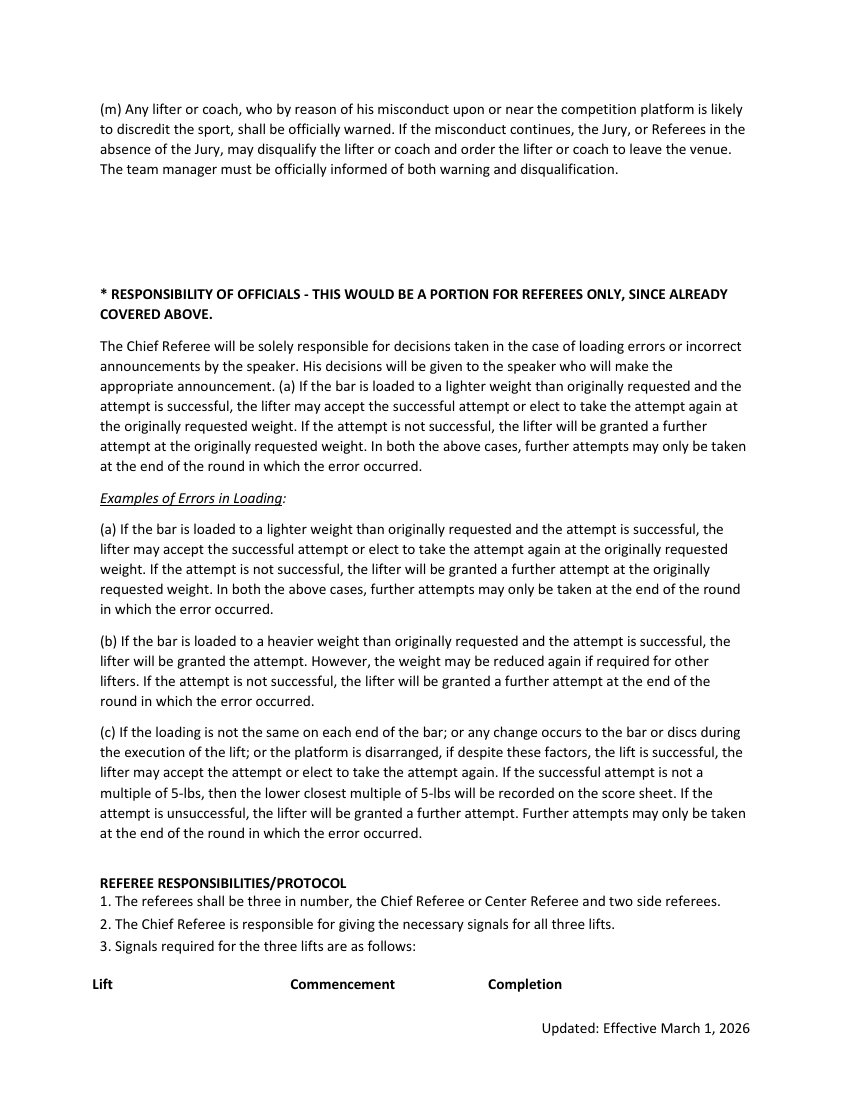
(m) Any lifter or coach, who by reason of his misconduct upon or near the competition platform is likely
to discredit the sport, shall be officially warned. If the misconduct continues, the Jury, or Referees in the
absence of the Jury, may disqualify the lifter or coach and order the lifter or coach to leave the venue.
The team manager must be officially informed of both warning and disqualification.


* RESPONSIBILITY OF OFFICIALS - THIS WOULD BE A PORTION FOR REFEREES ONLY, SINCE ALREADY
COVERED ABOVE.
The Chief Referee will be solely responsible for decisions taken in the case of loading errors or incorrect
announcements by the speaker. His decisions will be given to the speaker who will make the
appropriate announcement. (a) If the bar is loaded to a lighter weight than originally requested and the
attempt is successful, the lifter may accept the successful attempt or elect to take the attempt again at
the originally requested weight. If the attempt is not successful, the lifter will be granted a further
attempt at the originally requested weight. In both the above cases, further attempts may only be taken
at the end of the round in which the error occurred.
Examples of Errors in Loading:
(a) If the bar is loaded to a lighter weight than originally requested and the attempt is successful, the
lifter may accept the successful attempt or elect to take the attempt again at the originally requested
weight. If the attempt is not successful, the lifter will be granted a further attempt at the originally
requested weight. In both the above cases, further attempts may only be taken at the end of the round
in which the error occurred.
(b) If the bar is loaded to a heavier weight than originally requested and the attempt is successful, the
lifter will be granted the attempt. However, the weight may be reduced again if required for other
lifters. If the attempt is not successful, the lifter will be granted a further attempt at the end of the
round in which the error occurred.
(c) If the loading is not the same on each end of the bar; or any change occurs to the bar or discs during
the execution of the lift; or the platform is disarranged, if despite these factors, the lift is successful, the
lifter may accept the attempt or elect to take the attempt again. If the successful attempt is not a
multiple of 5-lbs, then the lower closest multiple of 5-lbs will be recorded on the score sheet. If the
attempt is unsuccessful, the lifter will be granted a further attempt. Further attempts may only be taken
at the end of the round in which the error occurred.

REFEREE RESPONSIBILITIES/PROTOCOL
1. The referees shall be three in number, the Chief Referee or Center Referee and two side referees.
2. The Chief Referee is responsible for giving the necessary signals for all three lifts.
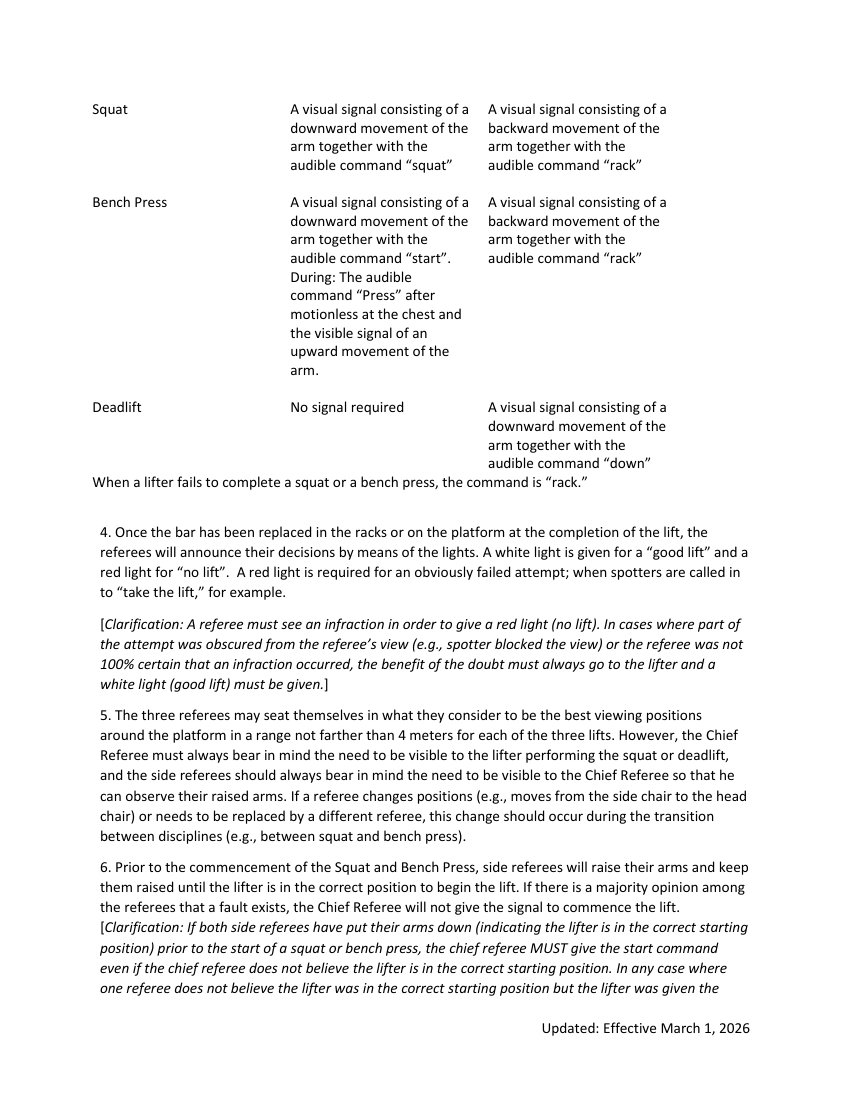
3. Signals required for the three lifts are as follows:

Lift

Commencement

Completion
Rulebook · Page 12
Read page 12 as text
Updated: Effective March 1, 2026
Squat  A visual signal consisting of a
downward movement of the
arm together with the
audible command “squat”
A visual signal consisting of a
backward movement of the
arm together with the
audible command “rack”

Bench Press

A visual signal consisting of a
downward movement of the
arm together with the
audible command “start”.
During: The audible
command “Press” after
motionless at the chest and
the visible signal of an
upward movement of the
arm.

A visual signal consisting of a
backward movement of the
arm together with the
audible command “rack”

Deadlift

No signal required

A visual signal consisting of a
downward movement of the
arm together with the
audible command “down”
When a lifter fails to complete a squat or a bench press, the command is “rack.”

4. Once the bar has been replaced in the racks or on the platform at the completion of the lift, the
referees will announce their decisions by means of the lights. A white light is given for a “good lift” and a
red light for “no lift”.  A red light is required for an obviously failed attempt; when spotters are called in
to “take the lift,” for example.
[Clarification: A referee must see an infraction in order to give a red light (no lift). In cases where part of
the attempt was obscured from the referee’s view (e.g., spotter blocked the view) or the referee was not
100% certain that an infraction occurred, the benefit of the doubt must always go to the lifter and a
white light (good lift) must be given.]
5. The three referees may seat themselves in what they consider to be the best viewing positions
around the platform in a range not farther than 4 meters for each of the three lifts. However, the Chief
Referee must always bear in mind the need to be visible to the lifter performing the squat or deadlift,
and the side referees should always bear in mind the need to be visible to the Chief Referee so that he
can observe their raised arms. If a referee changes positions (e.g., moves from the side chair to the head
chair) or needs to be replaced by a different referee, this change should occur during the transition
between disciplines (e.g., between squat and bench press).
6. Prior to the commencement of the Squat and Bench Press, side referees will raise their arms and keep
them raised until the lifter is in the correct position to begin the lift. If there is a majority opinion among
the referees that a fault exists, the Chief Referee will not give the signal to commence the lift.
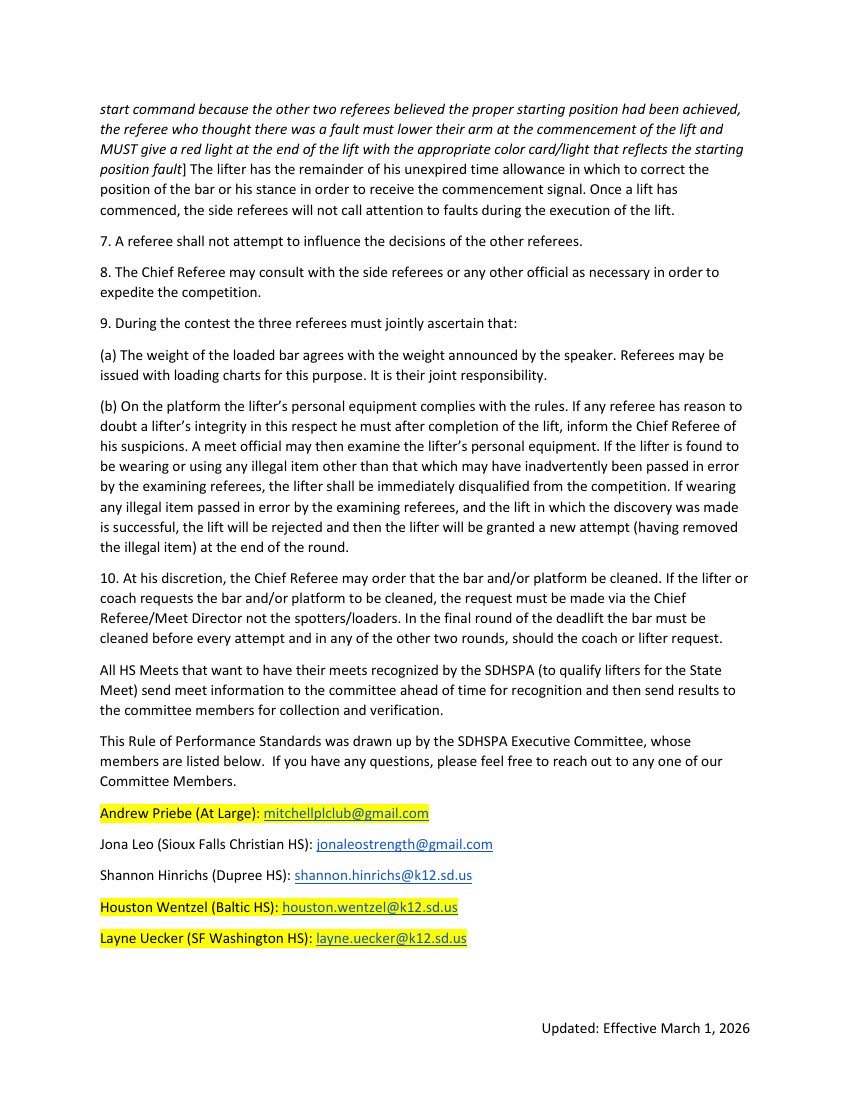
[Clarification: If both side referees have put their arms down (indicating the lifter is in the correct starting
position) prior to the start of a squat or bench press, the chief referee MUST give the start command
even if the chief referee does not believe the lifter is in the correct starting position. In any case where
one referee does not believe the lifter was in the correct starting position but the lifter was given the
Rulebook · Page 13
Read page 13 as text
Updated: Effective March 1, 2026
start command because the other two referees believed the proper starting position had been achieved,
the referee who thought there was a fault must lower their arm at the commencement of the lift and
MUST give a red light at the end of the lift with the appropriate color card/light that reflects the starting
position fault] The lifter has the remainder of his unexpired time allowance in which to correct the
position of the bar or his stance in order to receive the commencement signal. Once a lift has
commenced, the side referees will not call attention to faults during the execution of the lift.
7. A referee shall not attempt to influence the decisions of the other referees.
8. The Chief Referee may consult with the side referees or any other official as necessary in order to
expedite the competition.
9. During the contest the three referees must jointly ascertain that:
(a) The weight of the loaded bar agrees with the weight announced by the speaker. Referees may be
issued with loading charts for this purpose. It is their joint responsibility.
(b) On the platform the lifter’s personal equipment complies with the rules. If any referee has reason to
doubt a lifter’s integrity in this respect he must after completion of the lift, inform the Chief Referee of
his suspicions. A meet official may then examine the lifter’s personal equipment. If the lifter is found to
be wearing or using any illegal item other than that which may have inadvertently been passed in error
by the examining referees, the lifter shall be immediately disqualified from the competition. If wearing
any illegal item passed in error by the examining referees, and the lift in which the discovery was made
is successful, the lift will be rejected and then the lifter will be granted a new attempt (having removed
the illegal item) at the end of the round.
10. At his discretion, the Chief Referee may order that the bar and/or platform be cleaned. If the lifter or
coach requests the bar and/or platform to be cleaned, the request must be made via the Chief
Referee/Meet Director not the spotters/loaders. In the final round of the deadlift the bar must be
cleaned before every attempt and in any of the other two rounds, should the coach or lifter request.
All HS Meets that want to have their meets recognized by the SDHSPA (to qualify lifters for the State
Meet) send meet information to the committee ahead of time for recognition and then send results to
the committee members for collection and verification.
This Rule of Performance Standards was drawn up by the SDHSPA Executive Committee, whose
members are listed below.  If you have any questions, please feel free to reach out to any one of our
Committee Members.
Andrew Priebe (At Large): mitchellplclub@gmail.com
Jona Leo (Sioux Falls Christian HS): jonaleostrength@gmail.com
Shannon Hinrichs (Dupree HS): shannon.hinrichs@k12.sd.us
Houston Wentzel (Baltic HS): houston.wentzel@k12.sd.us
Layne Uecker (SF Washington HS): layne.uecker@k12.sd.us